

Situational Awareness and Psychological Awareness in Law Enforcement
This essay was written in anticipation of the upcoming annual conference of the Society for Police and Criminal Psychology (SPCP) in Atlanta, September 16–19, 2026, where I have been invited to present on the Help-Seeking Paradox. The term itself is not new, nor is the underlying problem. Research has repeatedly demonstrated that law enforcement officers may recognize psychological distress and acknowledge the potential value of professional assistance while nevertheless remaining reluctant to seek it. Concerns about stigma, confidentiality, occupational consequences, perceptions of weakness, and possible questions regarding fitness for duty may all influence the decision to disclose distress or seek psychological care (Karaffa & Koch, 2016; Bell et al., 2022; Grupe, 2023).
As I ready my nerves for that presentation, I want to introduce one concept from the larger discussion. Law enforcement officers are extensively trained in situational awareness. In the broader human-performance literature, Endsley (1995) described situation awareness as involving the perception of relevant elements in the environment, comprehension of their meaning, and projection of their likely status in the near future. In police work, this translates into the continuous assessment of people, movement, threats, available cover, escape routes, changing environmental conditions, and the likely behavior of others. Situational awareness is therefore not simply looking around; it is an active cognitive process that supports judgment and decision-making under rapidly changing conditions (Endsley, 1995).
This raises an important question: If situational awareness describes an officer’s disciplined awareness of what is occurring around the officer, should we devote comparable attention to developing awareness of what is occurring within the officer?
Research on police performance has further demonstrated that situational awareness cannot be separated entirely from the officer’s own physiological and psychological state. Andersen and Gustafsberg (2016), for example, found that officers trained to better regulate their physiological responses during realistic critical-incident scenarios demonstrated improved physiological control, situational awareness, overall performance, and use-of-force decision-making. When I trained in the academy we were put in front of a television using the ‘Shoot-Don’t Shoot” program that was designed to provide meaningful encounters that mimiced a dangerous encounter where the officer was pushed to decide whether it was a ‘shoot’ situation or were there other tool that may be more productive in the scenario. We were learning to feel what real gun calls might feel like. This was my first introduction to psychological awareness. Subsequent work associated with the International Performance, Resilience and Efficiency Program (iPREP) has continued to emphasize an officer’s ability to recognize and regulate autonomic arousal during demanding police encounters (Andersen et al., 2024).
Police officers are trained to recognize danger, maintain control, tolerate discomfort, and continue functioning under difficult circumstances. Those qualities are occupational strengths. Yet the same culture can make acknowledging psychological distress feel risky. An officer may recognize increasing anxiety, intrusive memories, sleep disruption, irritability, alcohol misuse, depression, or emotional exhaustion and still decide not to seek assistance because of concerns about stigma, confidentiality, firearm status, fitness-for-duty evaluation, promotion, assignment, or how colleagues and supervisors will respond.
For purposes of this discussion, I refer to this internal counterpart as psychological awareness. I do not suggest that psychological awareness represents a formally established counterpart to Endsley’s model. Rather, I use the term as an operational concept describing an officer’s capacity to recognize meaningful changes in his or her own psychological and physiological functioning—including alterations in arousal, emotion, attention, thinking, sleep, irritability, behavioral control, and recovery following stress. Related police research more commonly describes these capacities using terms such as self-awareness, emotion regulation, stress recognition, and self-regulation. Studies have demonstrated that these abilities can be strengthened through training and may improve officers’ capacity to recognize and manage their responses to occupational stress (Berking et al., 2010; McCraty & Atkinson, 2012; Grupe et al., 2021).
The distinction is deceptively simple. Situational awareness asks, “What is happening around me?” Psychological awareness asks, “What is happening within me?” An officer may become highly proficient at identifying subtle environmental indicators of danger while being considerably less practiced at detecting the gradual accumulation of stress within himself or herself. Changes in sleep, patience, concentration, alcohol use, emotional reactivity, relationships, or physiological arousal may develop incrementally and may therefore be more difficult to recognize than an immediate external threat.
This distinction becomes particularly relevant to the Help-Seeking Paradox. Recognition of distress must logically precede voluntary help-seeking, yet recognition alone may still be insufficient. Police culture may encourage emotional control, self-reliance, and continued occupational functioning even during periods of substantial distress. Research suggests that perceived public stigma can become internalized as self-stigma, producing more negative attitudes toward psychological assistance and ultimately reducing intentions to seek help (Karaffa & Koch, 2016; Grupe, 2023). Indeed, Grupe’s research suggests an especially important paradox: greater psychological distress may coexist with stronger perceived stigma and, indirectly, less willingness to seek assistance at precisely the point when assistance may be most useful.
There is therefore an important training implication. Police academies devote considerable effort to teaching officers to detect subtle changes in the external environment because failure to recognize those changes can compromise officer safety. We might reasonably ask whether officer wellness deserves a similar philosophy. Psychological awareness could be deliberately practiced as an internal form of scanning: noticing changes early, interpreting what they may signify, and determining whether corrective action is needed before stress develops into observable impairment.
This approach is consistent with the resilience research described by Andersen and colleagues in the Royal Canadian Mounted Police Gazette. In discussing their research with police officers, Andersen et al. (2017) noted that officers did not consistently connect their psychological and physiological reactions with their subsequent performance. Their work therefore incorporated realistic police scenarios in which officers could learn not simply tactical responses, but greater recognition and regulation of their own stress response.
Seen from this perspective, situational awareness and psychological awareness need not be competing concepts. They may be complementary officer-safety skills. Situational awareness protects the officer by improving recognition of risk in the environment. Psychological awareness may protect the officer by improving recognition of risk developing internally. Both require training. Both depend upon recognizing subtle changes before they become critical. And both may ultimately influence judgment, performance, resilience, and safety.
Perhaps this is where the discussion of the Help-Seeking Paradox should begin. Before asking why an officer did not seek help, we should first ask whether the officer had been trained to recognize the early internal indicators that help might be needed—and whether the organization had created conditions in which acting upon that recognition felt professionally safe.
Police officers are trained from the beginning of their careers to develop situational awareness. On every call, traffic stop, domestic disturbance, building search, or contact with an unknown individual, the officer is expected to continuously observe and interpret the environment. Who is present? Where are their hands? What is changing? Where are the exits? Where is cover? How far away is backup? What resources are available? What might happen next? Situational awareness is therefore more than simply looking around. It is a continuous process of perceiving information, assigning meaning to it, anticipating what may follow, and adjusting behavior accordingly.
Severe threat responses that are extended or frequently repeated can significantly raise the risk for physical and mental health conditions such as cardiovascular disease and anxiety disorders. “Although resilience — the ability to cope during and recover from stressful situations — is a common term, used in many contexts, we found that no research had been done to scientifically understand what resilience is among police.” as published in the Royal Canadian Mounted Police Gazette Magazine in 2017.
“The RCMP’s Incident Management Intervention Model similarly emphasizes continuous assessment of situational factors, subject behavior, officer perceptions, and tactical considerations as an encounter evolves.” RCMP 2017
Psychological awareness can be understood as the internal counterpart of situational awareness. Instead of continuously scanning the environment for meaningful changes, the officer learns to periodically scan within: How am I sleeping? Am I more irritable than usual? Am I thinking about a particular call when I do not want to? Am I drinking more? Am I withdrawing from my family? Am I unusually anxious, angry, numb, exhausted, or distracted? Am I recovering between shifts, or is the stress accumulating? These observations do not necessarily indicate psychological illness. They are information—just as changes in the external environment are information. Psychological awareness means noticing that information early enough to decide whether some response is warranted.
Situational Awareness May Provide the Bridge
The two skills therefore share an important underlying process:
For situational awareness, the object of attention is primarily the external environment. For psychological awareness, it is the officer’s internal environment. Situational awareness asks, “What is happening around me, and what do I need to do?” Psychological awareness asks, “What is happening within me, and what do I need to do?” Neither requires overreaction. Both require noticing meaningful change and responding proportionately.
This is why well-developed situational awareness may provide an unusually good foundation for teaching psychological awareness to police officers. The profession does not have to introduce an entirely foreign concept. Officers already understand the importance of monitoring changing conditions, recognizing subtle warning signs, avoiding complacency, anticipating deterioration, and taking corrective action before a situation becomes unmanageable. Psychological awareness applies much the same logic inward.
SCAN → RECOGNIZE CHANGE → INTERPRET → ASSESS RISK → CHOOSE A RESPONSE → REASSESS
There is also an important cultural advantage to framing wellness this way. Asking an officer to become more “psychologically minded” may sound clinical or disconnected from traditional police training. Asking the officer to apply an already highly valued professional competency—situational awareness—to his or her own physiological and psychological condition is different. Psychological awareness becomes another component of operational readiness rather than an admission of psychological weakness.
An officer would never be taught:
Ignore changing conditions until they become dangerous.
Yet, unintentionally, that is sometimes how behavioral health is managed. Agencies may wait until accumulated distress becomes visible through excessive sick leave, deteriorating relationships, alcohol problems, citizen or supervisory complaints, performance problems, or psychological crisis. The psychological-awareness model argues for the opposite:
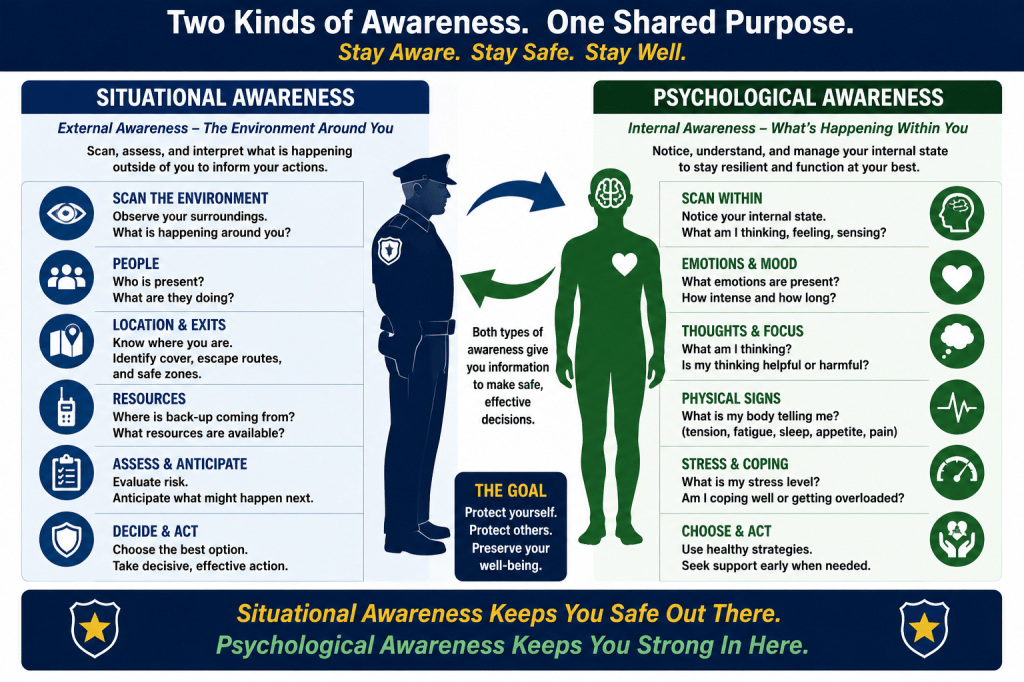
Notice change early → assess it → respond proportionately → reassess.
Training Under Realistic Conditions: The RCMP Example
Your emphasis in the blog on training under realistic conditions fits especially well here. The RCMP provides a strong operational example. Its Cadet Training Program uses a problem-based curriculum built around integrated, realistic, life-like situations, including scenarios, role-playing and practical exercises. Its continuing scenario-based training deliberately recreates real-life, high-stress situations in a controlled environment and requires officers to make decisions, assess risk, use de-escalation skills, and explain the reasoning behind their responses. Importantly, the scenarios are informed by data from actual police encounters rather than being purely abstract classroom exercises.
The RCMP has even incorporated material concerning acute and chronic stress and the mental-health effects of police work into its intervention training, including case material drawn from officers’ lived experiences. That is particularly relevant to your argument because it begins to connect operational competence with awareness of the psychological consequences of operational exposure.
The same training philosophy could be extended further. If realistic repetition helps an officer recognize external danger cues automatically, realistic wellness training could help officers recognize internal warning cues before those cues become severe. Following a demanding simulation, training need not end when the tactical problem has been solved. Officers could also be taught to ask: What happened to my heart rate and breathing? Did I experience tunnel vision? What was I thinking? How quickly did I recover? What reactions might persist after a real event? At what point would I talk with somebody?
That creates a powerful connection between the two concepts:
We train officers to scan the environment because early recognition of changing conditions can save their lives. We should also train officers to scan themselves because early recognition of changing psychological conditions may protect their health, judgment, relationships, careers—and, in some circumstances, their lives.
In that sense, psychological awareness does not compete with the traditional officer-safety model. It completes it. Situational awareness helps an officer remain safe and effective in the environment; psychological awareness helps that same officer remain healthy and effective across a career of repeated exposure to that environment.
These findings has important implications for police training. Officers spend considerable time learning situational awareness—continually assessing threats, people, movement, cover, distance, escape routes, and available resources. Andersen et al.’s findings suggest that comparable attention should be given to psychological awareness: recognizing changes in one’s own arousal, breathing, attention, cognition, emotional state, and behavioral readiness. In this sense, psychological awareness can be understood as the internal counterpart of situational awareness. The officer learns not only to scan the environment, but also to scan the self.
MICHAEL SEFTON
References
Andersen, J. P., Arpaia, J., Gustafsberg, H., Poplawski, S., & Di Nota, P. M. (2024). The International Performance, Resilience and Efficiency Program protocol for the application of HRV biofeedback in applied law enforcement settings. Applied Psychophysiology and Biofeedback, 49, 483–502. https://doi.org/10.1007/s10484-024-09644-3
Andersen, J. P., & Gustafsberg, H. (2016). A training method to improve police use of force decision making: A randomized controlled trial. SAGE Open, 6(2). https://doi.org/10.1177/2158244016638708
Andersen, J. P., Gustafsberg, H., Collins, P., Poplawski, S., & King, E. (2017). Performing under stress: Evidence-based training for police resilience. Gazette, 79(1), 16–18. Royal Canadian Mounted Police.
Bell, S., Palmer-Conn, S., & Kealey, N. (2022). “Swinging the lead and working the head”—An explanation as to why mental illness stigma is prevalent in policing. The Police Journal, 95(1). https://doi.org/10.1177/0032258X211049009
Berking, M., Meier, C., & Wupperman, P. (2010). Enhancing emotion-regulation skills in police officers: Results of a pilot controlled study. Behavior Therapy, 41(3), 329–339. https://doi.org/10.1016/j.beth.2009.08.001
Endsley, M. R. (1995). Toward a theory of situation awareness in dynamic systems. Human Factors, 37(1), 32–64. https://doi.org/10.1518/001872095779049543
Grupe, D. W. (2023). Mental health stigma and help-seeking intentions in police employees. Journal of Community Safety and Well-Being, 8(Suppl. 1), S32–S39. https://doi.org/10.35502/jcswb.290
Karaffa, K. M., & Koch, J. M. (2016). Stigma, pluralistic ignorance, and attitudes toward seeking mental health services among police officers. Criminal Justice and Behavior, 43(6), 759–777. https://doi.org/10.1177/0093854815613103
McCraty, R., & Atkinson, M. (2012). Resilience training program reduces physiological and psychological stress in police officers. Global Advances in Health and Medicine, 1(5), 44–66.


Leave a Reply